

Master of Business Administration
(MBA)
This Program is accredited by the MFHEA

Program Overview
This programme is designed for individuals who would like to acquire the knowledge, skills, and competencies to work in a managerial role in a business. To successfully complete the programme, a learner must be able to work with complex quantitative and qualitative data, make decisions in uncertain circumstances, and be accountable to stakeholders. Successful managers assume responsibility to design and implement strategy consistent with a firm’s long-term goals, manage costs and profitability, and supervise employees.
They are responsible for solving complex problems that involve financial issues, business strategy, organisational design, research findings, legal guidelines, and management of employees.
The environment in which successful managers operate is frequently uncertain and subject to difficult constraints. Graduates of the American University of Malta will have the critical thinking abilities and analytical framework to make difficult business decisions that affect multiple constituencies.
Program Information
GENERAL INFORMATION
MQF / EQF Level 7
18 Months ( Full-Time) program
36 Months ( Part-Time) program
Face-to-face / Online / Blended
ECTS: 92 US: 46
COURSE STRUCTURE
| MODULE CODE | MODULE / UNIT TITLE | COMPULSORY / ELECTIVE | ECTS / ECVETS | MODE OF DELIVERY | MODE OF ASSESSMENT |
| MGT 520 | Strategic Management | Compulsory | 6 | Lectures, Tutorials | Examination Assesment |
| FIN 520 | Economics for Managers | Compulsory | 6 | Lectures, Tutorials | Examination Assesment |
| MAT 501 | Business Statistics | Compulsory | 6 | Lectures, Tutorials | Examination Assesment |
| MGT 510 | Business Law | Compulsory | 6 | Lectures, Tutorials | Examination Assesment |
| FIN 530 | Managerial Accounting | Compulsory | 6 | Lectures, Tutorials | Examination Assesment |
| MGT 540 | Operations Management | Compulsory | 6 | Lectures, Tutorials | Examination Assesment |
| MGT 550 | Organization Design, Culture and Structurre | Compulsory | 6 | Lectures, Tutorials | Examination Assesment |
| MGT 500 | Writing and Presenting Academic Research | Compulsory | 6 | Lectures, Tutorials | Examination Assesment |
| MGT 560 | Marketing Management | Compulsory | 6 | Lectures, Tutorials | Examination Assesment |
| MGT 530 | Financial Management | Compulsory | 6 | Lectures, Tutorials | Examination Assesment |
| MGT 610 | Research Methods for Business | Compulsory | 6 | Lectures, Tutorials | Examination Assesment |
| FIN 510 | Financial Accounting | Elective | 6 | Lectures, Tutorials | Examination Assesment |
| FIN 540 | Money and Banking | Elective | 6 | Lectures, Tutorials | Examination Assesment |
| PHI 501 | Business Ethics | Elective | 6 | Lectures, Tutorials | Examination Assesment |
| MGT 620 | Research Project | Compulsory | 20 | Independent Study under faculty supervision | Thesis Evaluation |
| TOTAL ECTS / ECVETS for Course Completion | 92 | ||||
ENTRY REQUIREMENTS
For general Entry Requirements:
Please see the information on the Admission Page – Entry Requirements
DEGREE REQUIREMENTS
Successful Progress Requirement: Students must maintain a 3.0 out of 4.0 grade point average throughout the programme. Students whose performance fails to maintain this standard will be required to repeat modules with the lowest grades until they regain the required minimum GPA.
Should scheduling constraints prevent students from retaking a module within two semesters after falling below the acceptable GPA threshold, students may be allowed to enrol in new modules in a probationary state in order to raise their GPA.
Under no circumstances will students with a GPA below 3.0 be allowed to enrol in Research Methods and to enter the final semester to conduct the final research project. Assessment Methods: Assessment methods and policies vary according to each module. They are specified in the description of each module.
In general, foundation and core modules are assessed by written examinations and homework assignments. Advanced modules are assessed by written examinations, homework assignments, and case studies.
LEARNING OUTCOMES
Knowledge
Graduates will acquire knowledge of the following fields needed to manage a business or non-profit organisation:
a) Interpret, design, and apply a wide range of accounting, economics, and financial practical tools and data.
b) Evaluate, design, and apply comprehensive legal business policies and theoretical frameworks
c) Design and implement a multi-disciplinary organisational structure, design and culture
d) Develop and maximise the efficiency of marketing strategies.
e) Analyse consumer behaviour and business advertising.
f) Design and apply research and statistics methods (i.e., qualitative, and quantitative). g) Implement and combine different ICT approaches into a digital society-based
Skills
Graduates will develop the following skills used in managing a business:
a) Analyse competitive threats and differentiate between the complexities of external influences on business activity.
b) Apply appropriate statistical and financial investment techniques and tools to business data in order to make successful business decisions.
c) Apply performant operation management, including cost management.
d) Measure and predict the impact of macroeconomics’ indicators movements, including but not limited to financial systems, business cycles, labour markets, monetary and fiscal policy
e) Design a business structure indicating a clear understanding of the legal issues relevant to business, including contracts, liability, fraud and dispute resolution
f) Use research results to justify business decisions, and the impact of general and specific environment business factors and internal financial data to develop new strategies and tactics for business development
g) Classify the business’ most valuable customers and prepare a strategy to maintain the organization’s market position.
Competences:
Graduates will develop the following competences:
a) Create innovative solutions to complex business problems.
b) Be responsible for activities that affect business outcomes, including but not limited to financial management and reporting, strategy development and implementation, operations, marketing and employee management.
c) Make unbiased decisions that are supported by data rather than gut feelings.
d) Comply with professional standards and laws and demonstrate the highest business and professional ethics.
e) Design business plans that will create value for the organisation and its stakeholders.
f) Implement digital dedicated technology to take the business decisions in a more timely manner
PEDAGOGICAL METHODS
The MBA comprises 3 semesters of full-time coursework and completion of a major independent research project in the fourth semester. The courses are sequenced such that later courses leverage material learnt in earlier courses. I
n general, the pedagogical approach of the introductory and core modules comprises lectures, frequent homework, and exams. The advanced modules incorporate case studies and group projects.
The Research Methods module requires students to develop a proposal for the research project in the second semester. Students must finish the Research Methods for Business module in the second Semester with a proposal for the independent research project, which needed to be completed in the final semester.
EMPLOYABILITY/CAREERS
Notwithstanding the inflation of MBA programmes on the international market, it is still true that graduates of quality MBA programmes acquire knowledge, skills, and competencies that position them already a step ahead in career paths of graduates of bachelor programmes or of other master’s degrees.
Graduates of a quality MBA programme not only enter the workforce with higher salaries than other master’s graduates but also have higher chances of obtaining and holding a high-level management position in their companies. For all these reasons, AUM considers the MBA as a strategic degree program to offer at the outset to serve the population working at a professional level in Malta, who are looking for the opportunity to obtain a proficient qualification that will significantly enhance their careers at the national and international level.
Graduate students may apply for the following positions in any field, such as but not limited to:
- Marketing Manager
- Medical, Educational, and Health Services Manager
- Management Consultant
- Financial Manager
- Business Operations Manager
- Accounting Consultant or Manager
- Financial Consultant
- Business Development Consultant
- Tourism Manager
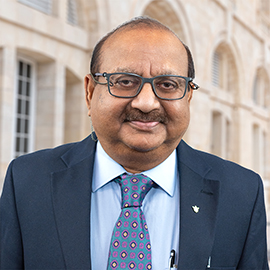
Prof. Dr. Ashok Srivastava
Professor of Business Management
Contact the Director for this Program
Prof. Dr. Ashok Srivastava
Email: [email protected]
Phone: +356 2169 6970